
Why You Should Never Automate First: The Rule Every Business Needs Before They Touch AI
By Branden Bodendorfer • • OnFocus Business
Every business is automating. Most are doing it in the wrong order.
Ask any business owner what they are doing with AI tools this year and most will give you the same answer: automating. Customer follow-ups, marketing campaigns, scheduling, data entry, reports. The tools are everywhere and they are genuinely useful.
But there is a problem almost nobody talks about. The question is not whether to automate. It is whether the process you are about to automate was worth keeping in the first place.
Most are not.
Businesses accumulate process steps the way houses accumulate junk. A step gets added to fix a problem. Another gets added to create accountability for the first step. A third gets added because someone complained. Over time, the process is carrying weight it was never designed for. Then someone buys an AI tool and puts it on top of the whole pile.
What you get is a faster, more consistent version of something that should not have existed. The AI does not know that. It just runs the process you gave it.
The rule most people skip: automate last
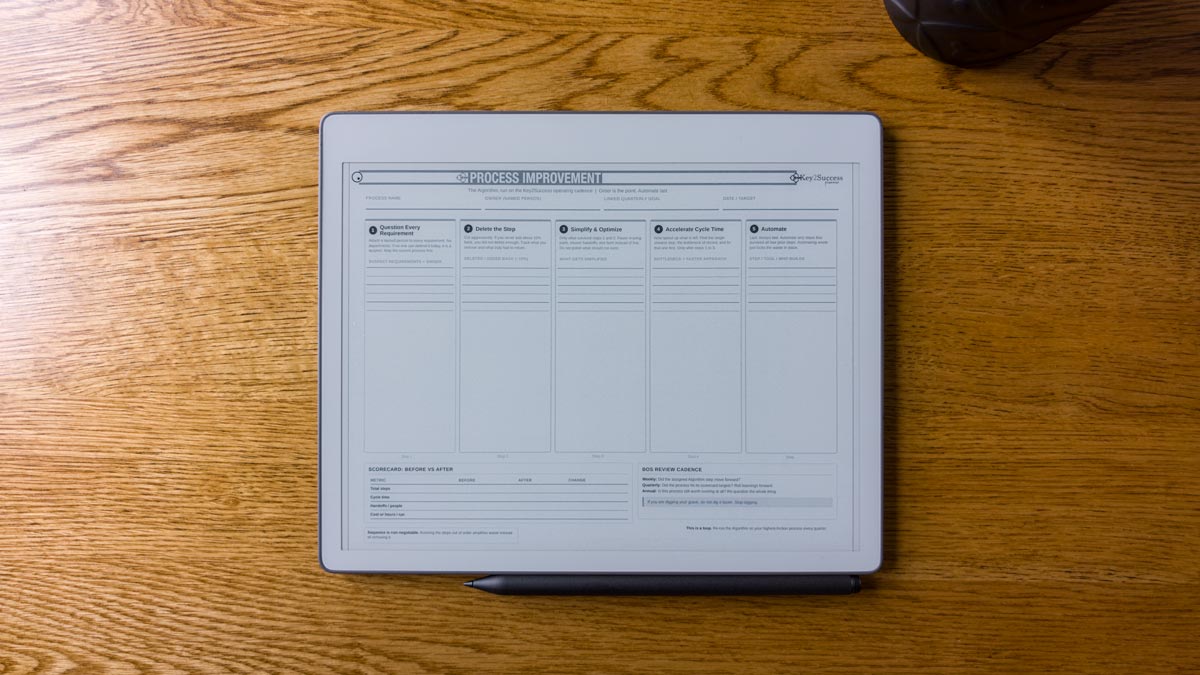
Elon Musk developed a five-step process improvement framework at SpaceX and Tesla, documented in Walter Isaacson's 2023 biography. The five steps in order: question every requirement, delete every unnecessary step, simplify and optimize, accelerate cycle time, then automate.
The last step is where most people start.
Musk admitted the mistake himself. In his own words from the Isaacson biography: "The big mistake in Nevada and at Fremont was that I began by trying to automate every step. We should have waited until all the requirements had been questioned, parts and processes deleted, and the bugs were shaken out."
That was Tesla. One of the most sophisticated manufacturing operations in the world. They still got it wrong by automating too early.
If it happened there, it is happening in your business too.
"Automating a broken or unnecessary process makes the wrong thing happen faster and at scale."
Why this matters more right now than it ever has
The reason this rule matters so much in 2026 is that the barrier to automation has essentially disappeared. You do not need a development team or a six-figure software budget. You need a subscription and an afternoon.
That accessibility is a good thing. But it also means the cost of getting the order wrong has dropped to zero up front and compounded on the back end. You can automate a broken process in an hour. Unwinding it six months later, after the bad process has been running at speed and scale, costs considerably more.
Jon McNeill, who served as president of Tesla when revenue grew from $2 billion to $20 billion in 30 months, expanded Musk's framework in his 2026 book The Algorithm. His observation: the most dangerous moment for any business is when a flawed process becomes invisible because automation made it consistent. When something runs badly by hand, people notice and complain. When it runs badly by machine, it just runs.
Three questions to ask before you automate anything
You do not need to run the full five-step Algorithm to get value from the automate-last principle. Three questions, answered honestly, will tell you whether your process is ready to automate.
1. Can you name the person who required each step?
Not the department. The person. If a step in your process exists because "the team decided" or "we've always done it that way," that step has no named owner and almost certainly should not exist. Requirements without named owners survive process reviews by hiding behind collective memory. They do not survive a direct question.
2. What happens if you remove this step entirely?
Ask it about every step. Most people assume the answer is "everything breaks." Usually it is not. Musk's rule of thumb: if you delete aggressively and do not need to add back at least 10% of what you removed, you were not aggressive enough. The add-back is expected. It is not failure. It is calibration.
3. What is the single most expensive bottleneck right now?
Not the most obvious one. The most expensive one. The step that is costing you the most time, the most errors, or the most downstream rework. Fix that one first before you touch automation. Automating around a bottleneck does not eliminate it. It moves it.
If you can answer all three clearly, your process is ready to automate. If you cannot, the AI tool is not your next step. The process review is.
What this looks like in practice
A few months ago I ran a multi-department sales process through Musk's framework. The process had more than 30 steps firing over a 14-day period and touched marketing, sales, a retention team, and management. It had been built over years, with new steps added every time something went wrong.
When we started questioning requirements in step one, we found a customer who had come in looking for a larger SUV for her growing family. An expecting mother with a clear need and genuine interest. She had been marked as a bad lead and pushed back to marketing as a truck buyer. Nobody did that deliberately. The process did it, because nobody owned her original intent across the handoffs.
We cut from 30 steps to 12 in the first pass. Three months later we reviewed again and cut to 9. Lead-to-close ratio went from 9% to 12% in the first 30 days.
Had we automated that 30-step process instead of reviewing it, we would have automated a system that was converting buying customers into cold prospects. Faster. More consistently. At scale.
That is the automate-last rule in real terms.
Where to start
If you want to run the full five-step framework on a process in your business, Branden Bodendorfer has published a step-by-step implementation guide on his site, along with a downloadable worksheet that walks you through each step. The guide includes a worked example from a real multi-department process and the daily planning structure that keeps improvements from falling apart after the first session.
The Algorithm Process Improvement System is also available as a $19.99 downloadable template — a one-page process improvement worksheet and a before/after process map, built specifically to run any business process through all five steps.
The AI tools are not the problem. The order is the problem. Get the process right first. Then automate.
Frequently asked questions
Quick answers
- Does this apply to small businesses, not just large companies?
- Yes. The automate-last principle applies to any business of any size. Small businesses are actually more vulnerable to this mistake because they often have fewer resources to recover from a bad automation investment.
- What AI tools are most commonly automated too early?
- CRM automations, email marketing sequences, customer follow-up workflows, and social media scheduling are the most common. All of them run on top of processes that are often never reviewed before the tool is turned on.
- How long does a process review take before automating?
- A focused review of a single business process can be completed in a half-day session. The five-step framework is designed for speed, not extended consulting engagements.
- Is the automate-last rule specific to Elon Musk's framework?
- The principle appears in other process improvement frameworks, but Musk's Algorithm is the clearest articulation of why the order matters and what happens when it is violated. His own admission about Tesla is the most direct case study available.
- Where can I read the full five-step implementation guide?
- Branden Bodendorfer published a full step-by-step guide at brandenbodendorfer.com, including a worked example from a real business process and a downloadable worksheet.
About Branden Bodendorfer
Branden Bodendorfer is the creator of Key2Success Planner, a digital planning system used in 52+ countries, and Director of Marketing at Wheelers Family Auto Group in central Wisconsin. He has 20+ years of experience in business, marketing, and coaching. Connect on LinkedIn or visit brandenbodendorfer.com.
Sources
- Isaacson, W. (2023). Elon Musk. Simon & Schuster. Algorithm documented via Farnam Street
- McNeill, J. (2026). The Algorithm: The Hypergrowth Formula That Transformed Tesla, Lululemon, General Motors, and SpaceX. Portfolio/Penguin.
- Bodendorfer, B. (2026). How to Apply Elon Musk's Algorithm: A Step-by-Step Implementation Guide. brandenbodendorfer.com

Author: News Desk
Share this:
- Share on X (Opens in new window) X
- Share on Facebook (Opens in new window) Facebook
- Share on LinkedIn (Opens in new window) LinkedIn
- Share on Tumblr (Opens in new window) Tumblr
- Email a link to a friend (Opens in new window) Email
- Share on Reddit (Opens in new window) Reddit
- Print (Opens in new window) Print